
Picture stories
Sometimes paintings and words gotta hold hands

Last year a local winery invited me to show some of my art at their tasting room. Most of the pieces were illustrations I had done to accompany my own writing; some were tales unto themselves. As I explained how each came to be to folks who attended the show opening, I realized that this sharing of stories was part of what made the images complete. They stood on their own as beautiful mysteries, yes. But when attached to a narrative, each became an experience that was more than just words or pictures could be on their own.
In that spirit, as I wrap up my spring sale on archival art prints between now and June 2nd (35 percent off everything!), I wanted to share with you in brief the stories of some of the pictures you’ll find at Hidden Drawer Designs.
Mountain lions
I have lived most of my life in mountain lion habitat, but I never saw one until I moved to the Methow Valley in Washington state. It happened during my third month living in a rented room in a woodsy subdivision bordering national forest. I was deep into writing for a magazine deadline and deeply in need of a break from the computer. The Methow is far enough north that darkness comes early in the winter, so I left my desk midafternoon with my dog to climb a trail that wound up through the trees to a little knoll that overlooked the valley floor. It was February and foggy and the forest was close and wet and hushed, and so we stayed quiet too. As we neared the top, my dog suddenly looked left and froze, and I instinctively followed her gaze.
There, very close by, was a cougar—still woolly with youth, but big enough that the hair on the back of my neck prickled. I hoisted my dog onto my shoulders and began to yell, but the cougar only circled and kept its eyes locked on us. After a few minutes of stalemate, I backed down the trail until the cat was out of view, then began a speedy hike down, only to find the animal following me. This time, yelling and waving my arms seemed to do the trick.
The encounter led to another sighting a couple weeks later on a dark highway, where an adult cougar ambled through the headlights of my truck. My curiosity piqued, I researched and wrote a story for High Country News about what we know—and don’t know—about these animals. But more than that, the piece ended up exploring how people freight other beings with meanings and lore that say more about us than about them. These are two of the paintings I did for that story:
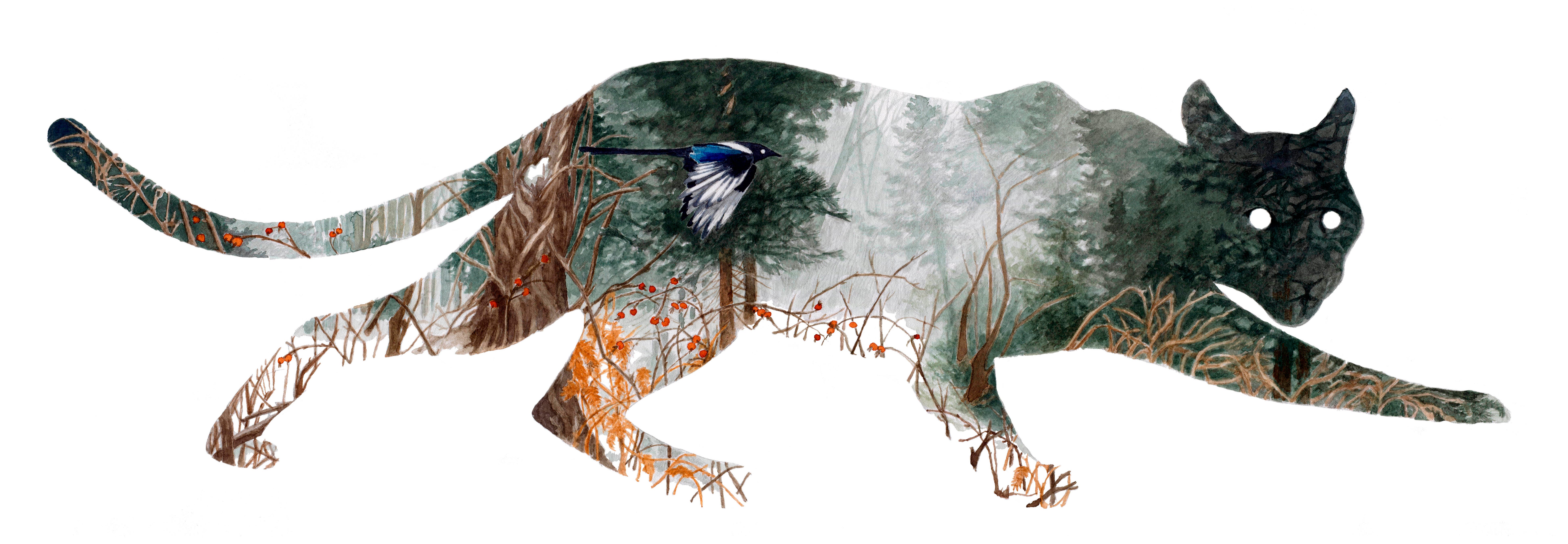
“Forest ghost” is meant to show the way that cougars are so of their places that when you see one, it is like a piece of the land itself has torn free to walk towards you.
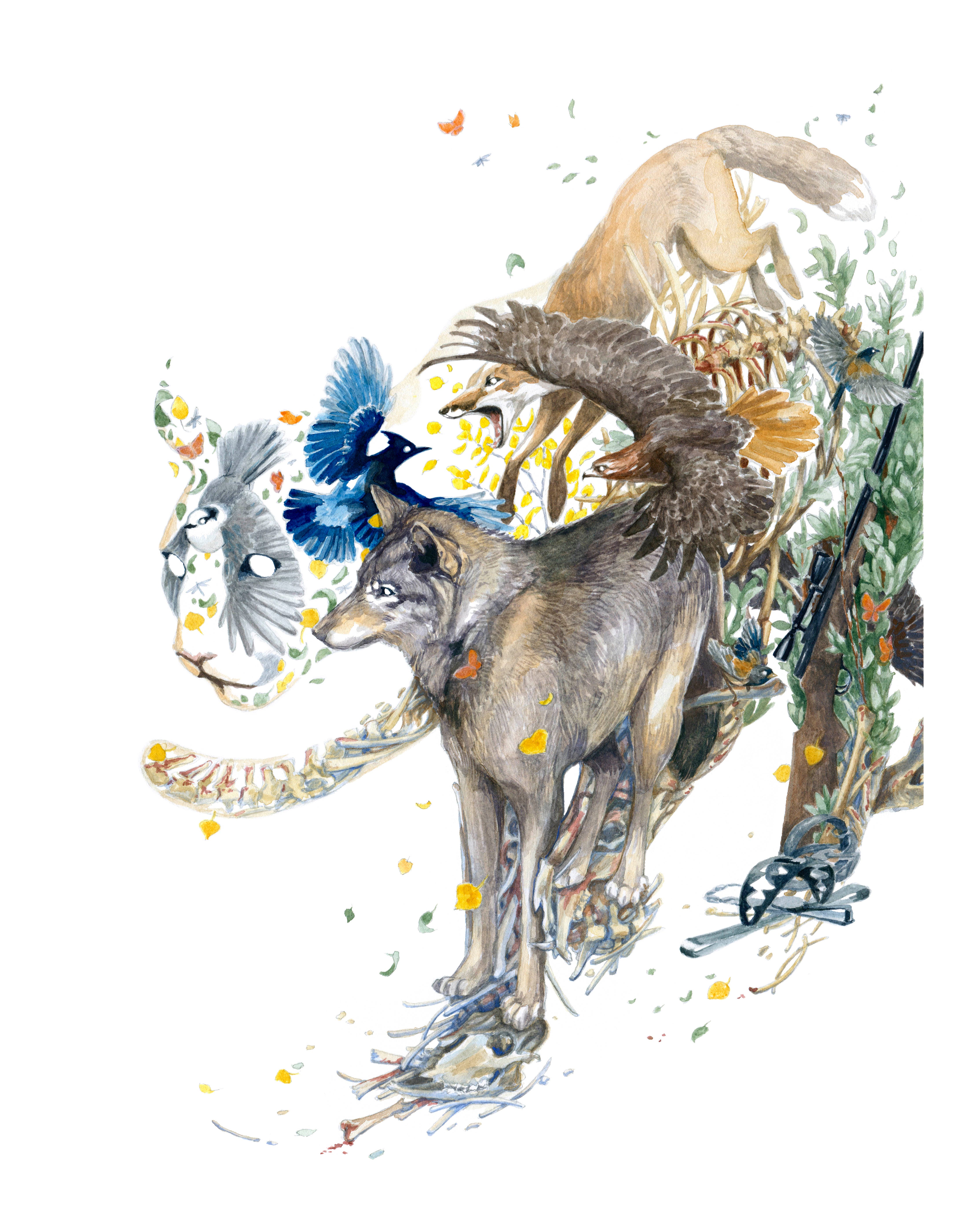
“Mountain lion menagerie,” meanwhile, is meant to show all the stories these animals carry, from the webs of life they support with their kills, to the myth-making and cruelty they inspire in people.
Reindeer
In 2019, I was lucky enough to join a research expedition to St. Matthew, an uninhabited island 200 miles off the Alaska mainland in the middle of the Bering Sea. Supposedly, it is the most remote place in the state, and among the most remote places in the world. Archaeologists visiting St. Matthew have found no evidence of permanent human occupation. Both before and within the historical record, people came to St. Matthew, but they never stayed, and once they were gone, the roaringly mutable Bering Sea and the enigmatic island seemed to do their best to erase any traces these visitors left behind.
One of those traces was quite large—a herd of a couple dozen reindeer introduced by the U.S. military during World War II as a backup food supply for men serving at a navigation site on the island’s exposed western shore. When the war ended, the reindeer remained behind, ballooning to a population of 6,000, before a single harsh winter in the 1960s killed nearly all of them. By the time I set foot on St. Matthew’s foggy, velvety tundra, all that seemed to remain of these animals was a few handspreads of antlers, poking from the ground.
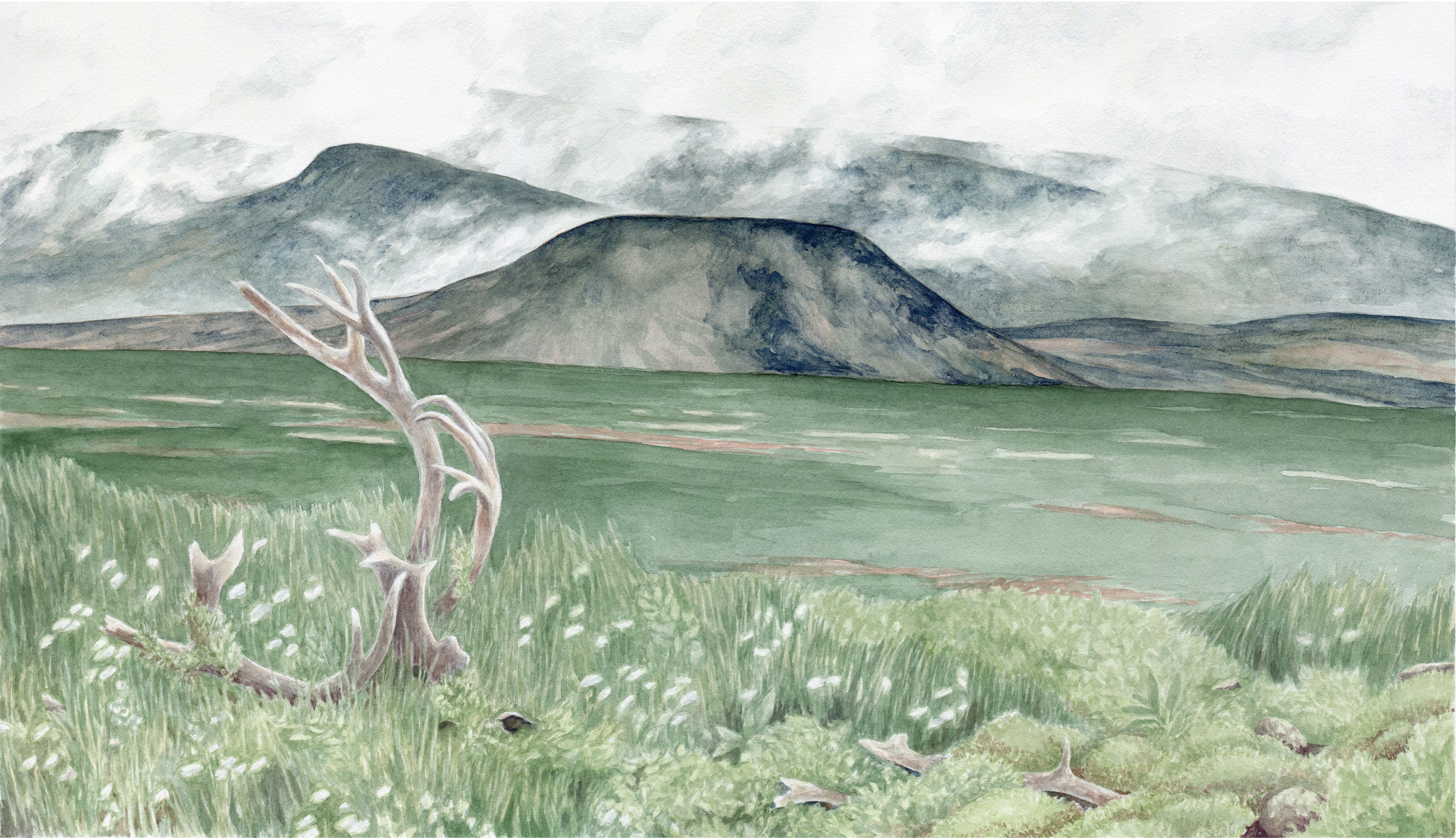
I wrote this story about St. Matthew’s self possession and mystery (along with a few others about science happening there), and later did this watercolor, “Island of Ghosts,” about the vanished reindeer for a show at the International Gallery of Contemporary Art in Anchorage. (And yes, I’m aware that that’s two ghosty paintings in a row, but hey, I’m a spooky gal.)
Desert hermit
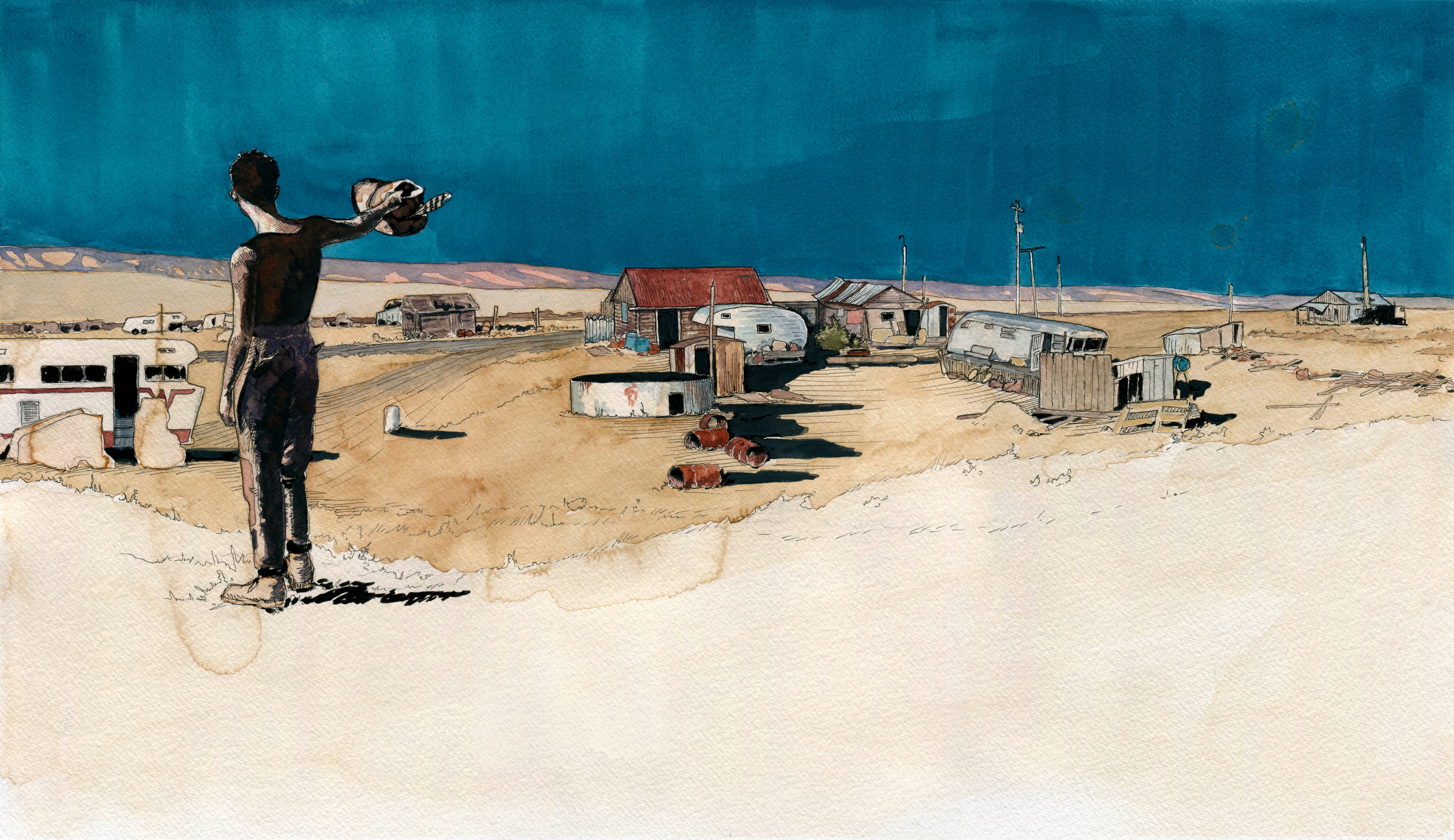
I grew up in the Southern Rockies, and now that I live in the Pacific Northwest, I often take time in the fall to drive back there to see family and friends and sometimes report and write stories. One year, as I was on my way back north, my friend Farland reached out and told me that I had to meet a young woman named Eileen Muza that she had encountered in Cisco, a ruin of an old Utah town not far from Moab. It wasn’t far out of my way, so I stopped to visit Eileen, a thirty-something with a shaved head and a deeply tanned face who had bought a chunk of Cisco for a pittance. It was the only home in America she could afford, Eileen told me, and she was working to build herself a world there out of scraps that others had abandoned. Her friend Michael Gerlach was visiting too, and Eileen led us to half an empty oil tank, its roof open to the sky, its walls decorated with graffiti, where Michael sang us a heart-opening song on his guitar, made all the sweeter for the acoustics of that rusted metal.
The story of Eileen, and the story of this place, felt like it held a larger story of what it means to try to make a life in our increasingly hot, fractured, and unaffordable world—a story of building something beautiful out of the ruins. So I wrote and drew this essay about Eileen’s wild life for High Country News.
“Pioneer of Ruin” is my cover portrait of Eileen on the back porch of her salvaged cabin:
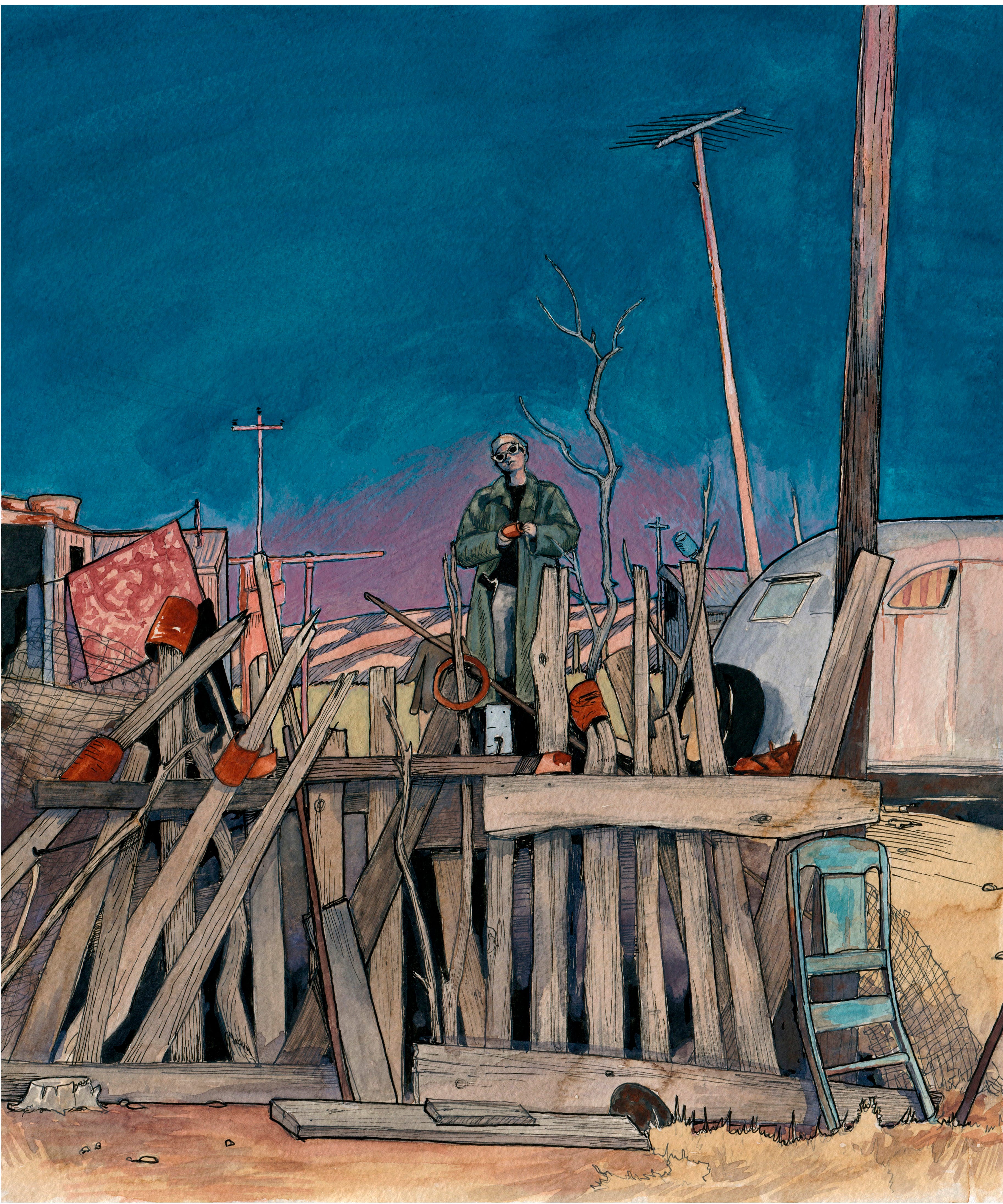
“Eileen in the Desert” shows Eileen’s world: The Unknown, the abandoned oil field, the Book Cliffs, and all that beautiful overexposed sky:
Inkscapes
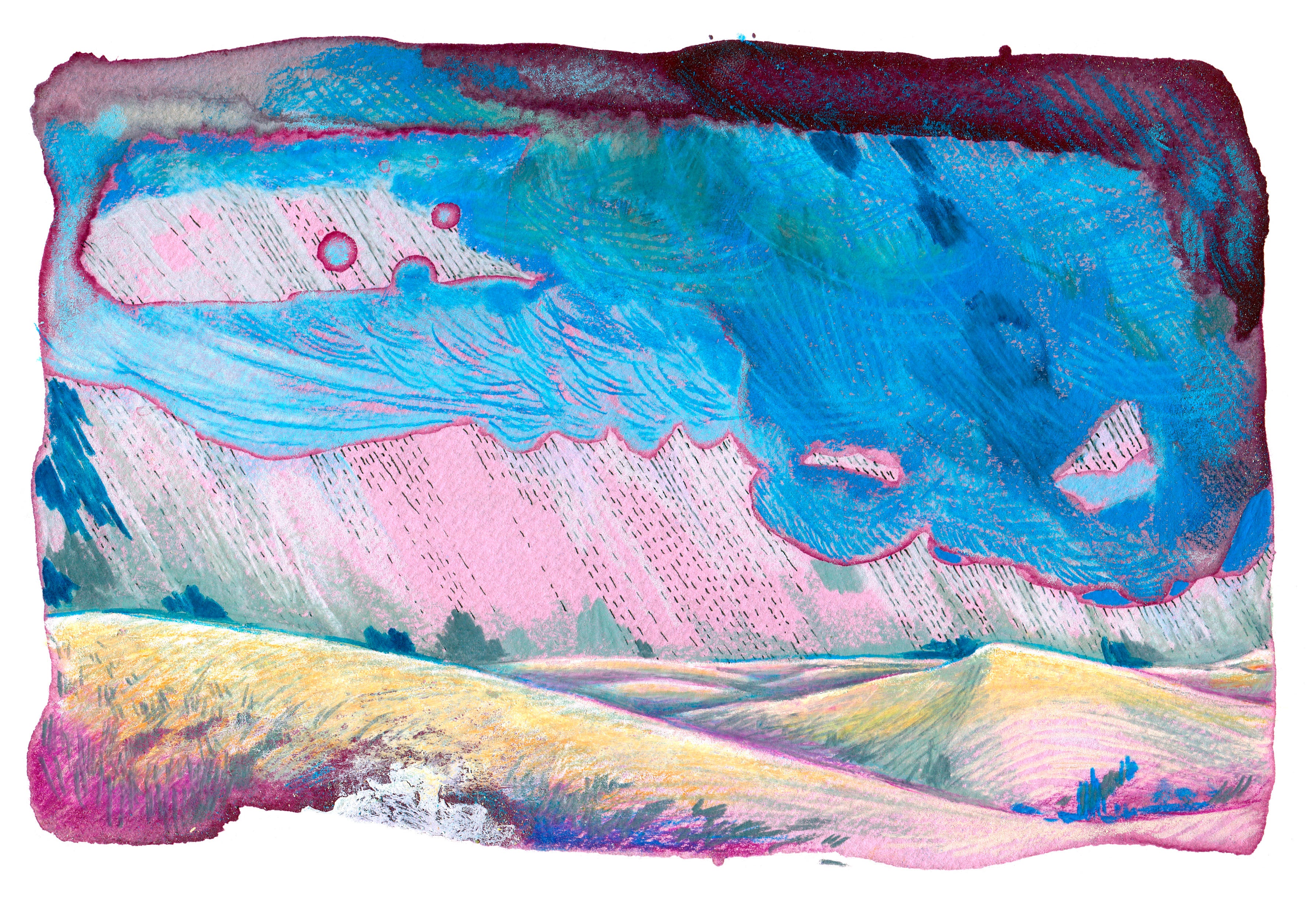
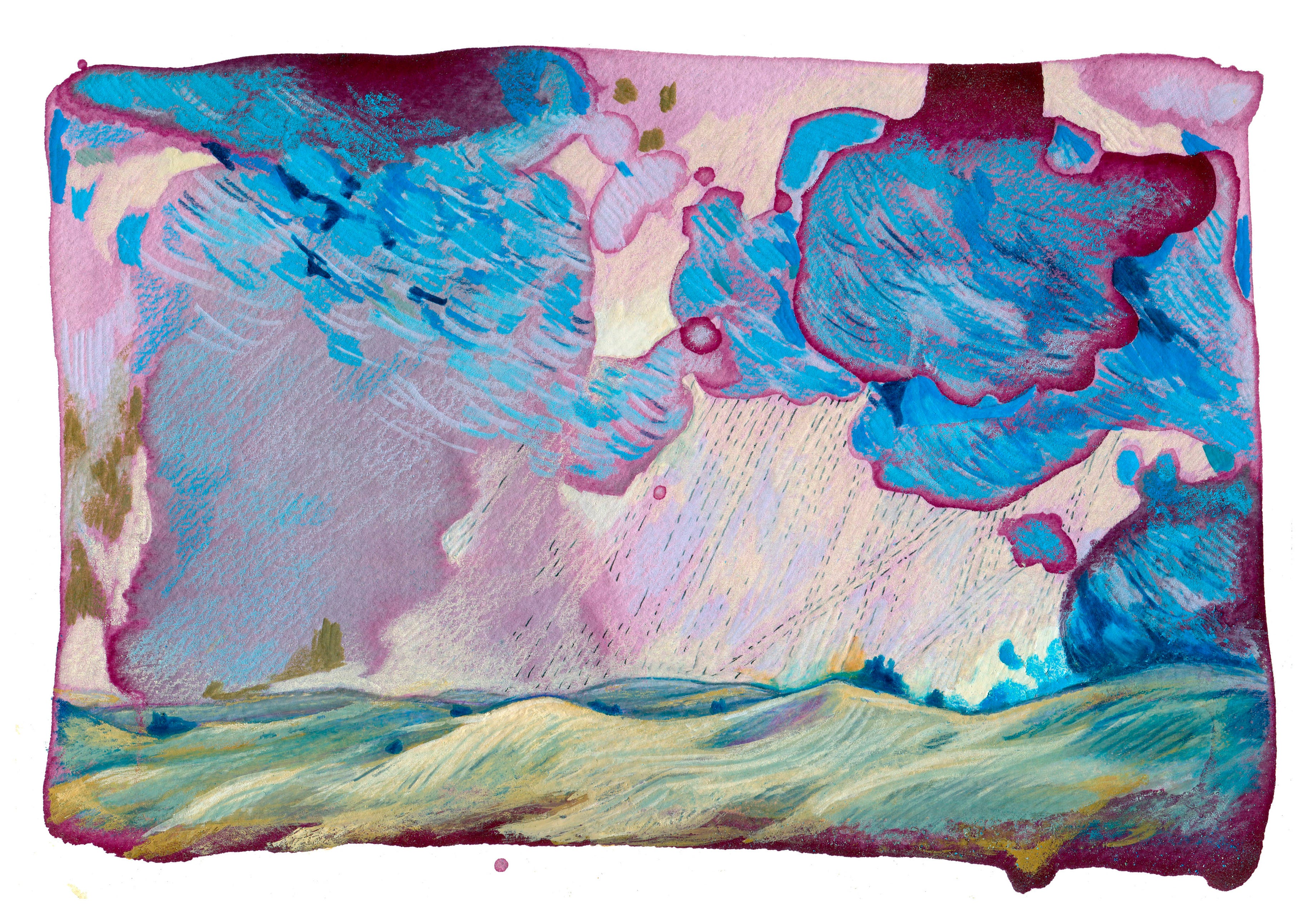
When the pandemic first took hold, in the early months of 2020 lockdown, I had a really hard time writing for work. The world had gotten both very small—my little apartment on a shared plot of land—and extremely big—with flights and travel across state and international borders rendered completely uncertain. I looked at the meadow outside my window with new attention. On a hike with a friend, I noticed that ponderosa pine pollen cones were magenta. The color was so luscious I wondered if I could render a pigment from it, and maybe from some other plants too. So I got all witchy and collected batches of flowers and lichen and leaves and cones, and boiled them each in a jar in the microwave to make a “landscape painting” made from the landscape itself. You can read more about that exercise here. These two images are one result of that period of suspended time and exploration. “Stormlights I” and “Stormlights II” are colored pencil drawings of the Methow Valley atop a pigment I rendered from those local ponderosa pollen cones.
That’s just a small sampling of what you’ll find over at Hidden Drawer Designs. If, while you explore that site, you wonder about the story behind another image, send me a message and I’ll share it with you. Thanks so much for taking the time to read my words and peep my paintings—I hope they help you see more big brightness in our world.
Oh, how the story of Eileen from your HCN piece stays with me. I remember being at an HCN event in Seattle and someone bringing their copy of the magazine to the gathering and saying, "More stories like this." The rest of us nodded in agreement. So evocative of how we can go be with place, be shaped by it, help form it, as well appreciate it and our own possibilities. I take pleasure knowing Cisco existed, that communities like it rise up in this world for a time. Thank you.
I'm still curious about the Steller's Jay and Cougar connection. My sense is forest ghosts don't like being announced by sentinel corvids. The next time I'm wandering the balsamroot slopes along the trails that connect into the Rendezvous system I'll remember to think about cat tracks in addition to migratory birds and the local coaches' training intervals.